

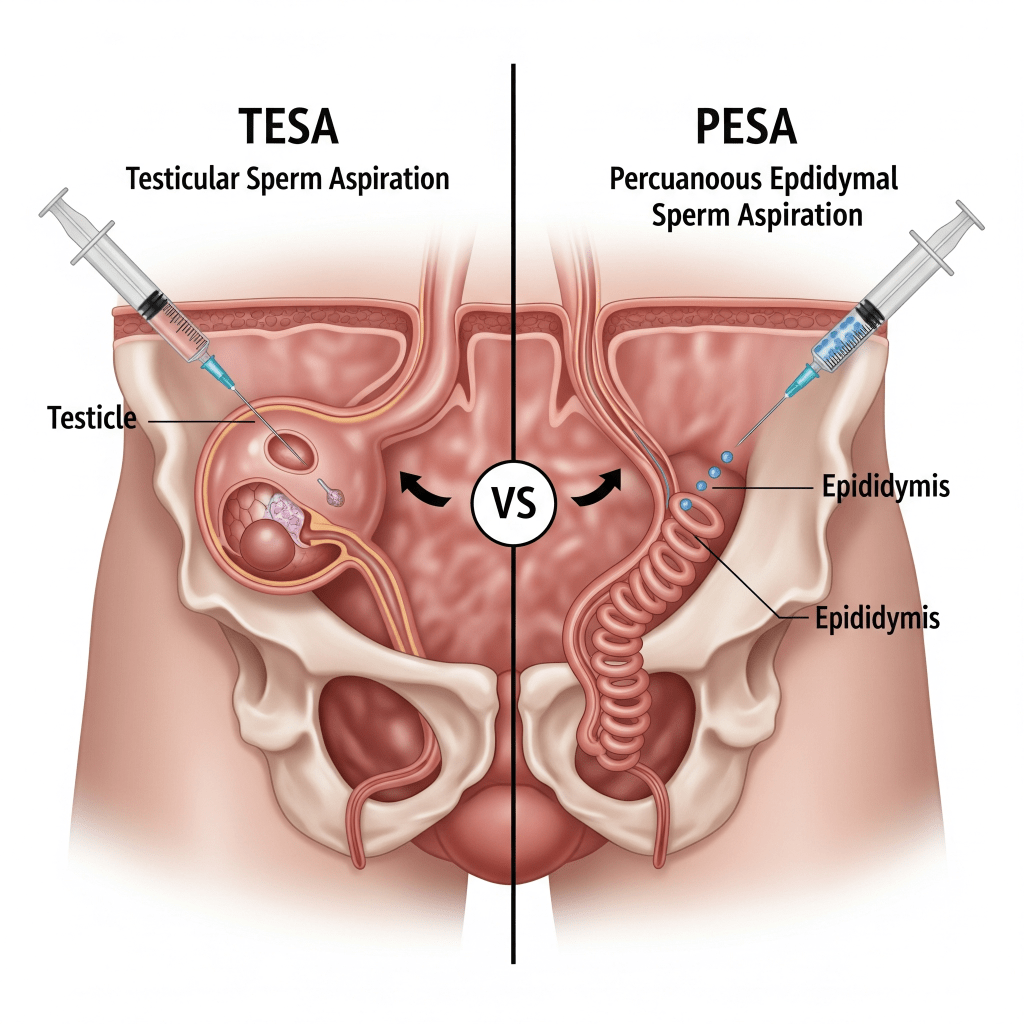
Advanced Sperm Retrieval Techniques: TESA, PESA, and TESE
For men with male factor infertility, including those with no sperm in their ejaculate, several advanced techniques can be used to retrieve viable sperm directly from the reproductive tract. These methods, often combined with Intracytoplasmic Sperm Injection (ICSI), have revolutionized the treatment of male infertility.
Testicular Sperm Aspiration (TESA)
Testicular Sperm Aspiration (TESA) is a quick and painless procedure performed under local anesthesia. A fine needle is used to extract sperm directly from the testis. This technique is highly effective for men with obstructive azoospermia, where sperm production is normal but the reproductive ducts are blocked (e.g., due to a vasectomy or congenital condition).
- Who it helps:
- Men who have had a vasectomy and wish to have children without undergoing complex reversal surgery.
- Men with spinal cord injuries or other neurological conditions that prevent ejaculation.
- Men who produce sperm but have no sperm in their ejaculate.
Even a small number of retrieved sperm can be sufficient for a successful pregnancy when used with ICSI, which involves injecting a single sperm directly into an egg. TESA is a non-surgical alternative to older, more invasive procedures, offering a faster recovery and immediate results.
Percutaneous Epididymal Sperm Aspiration (PESA)
Percutaneous Epididymal Sperm Aspiration (PESA) is a technique similar to TESA but targets the epididymis, a coiled tube behind the testis where sperm mature and are stored. Using a small needle and syringe, sperm are aspirated without a surgical incision. This method is particularly useful for men with blockages in the epididymis due to prior infections or a congenital absence of the vas deferens.
- How it works: The retrieved sperm are sent to the laboratory where they are identified and prepared for ICSI. This procedure can also be used for men who cannot ejaculate after prostate removal surgery.
Testicular Sperm Extraction (TESE)
For a specific group of men who have no sperm in their semen and whose testicular biopsies have shown no sperm production in the past, Testicular Sperm Extraction (TESE) offers a chance at fatherhood. This procedure involves taking a small biopsy from the testis, which is then meticulously searched for viable sperm in the laboratory for several hours. Even in cases of confirmed testicular failure, TESE can yield sperm and has a success rate of 10-30% for achieving pregnancy with ICSI.
- Who it helps: Men with non-obstructive azoospermia.
At our clinic, we perform all these advanced procedures to provide comprehensive care for male infertility. We utilize these techniques in conjunction with ICSI to maximize the chances of successful fertilization and pregnancy. rate.
 Rhia Fertility and IVF Centre